
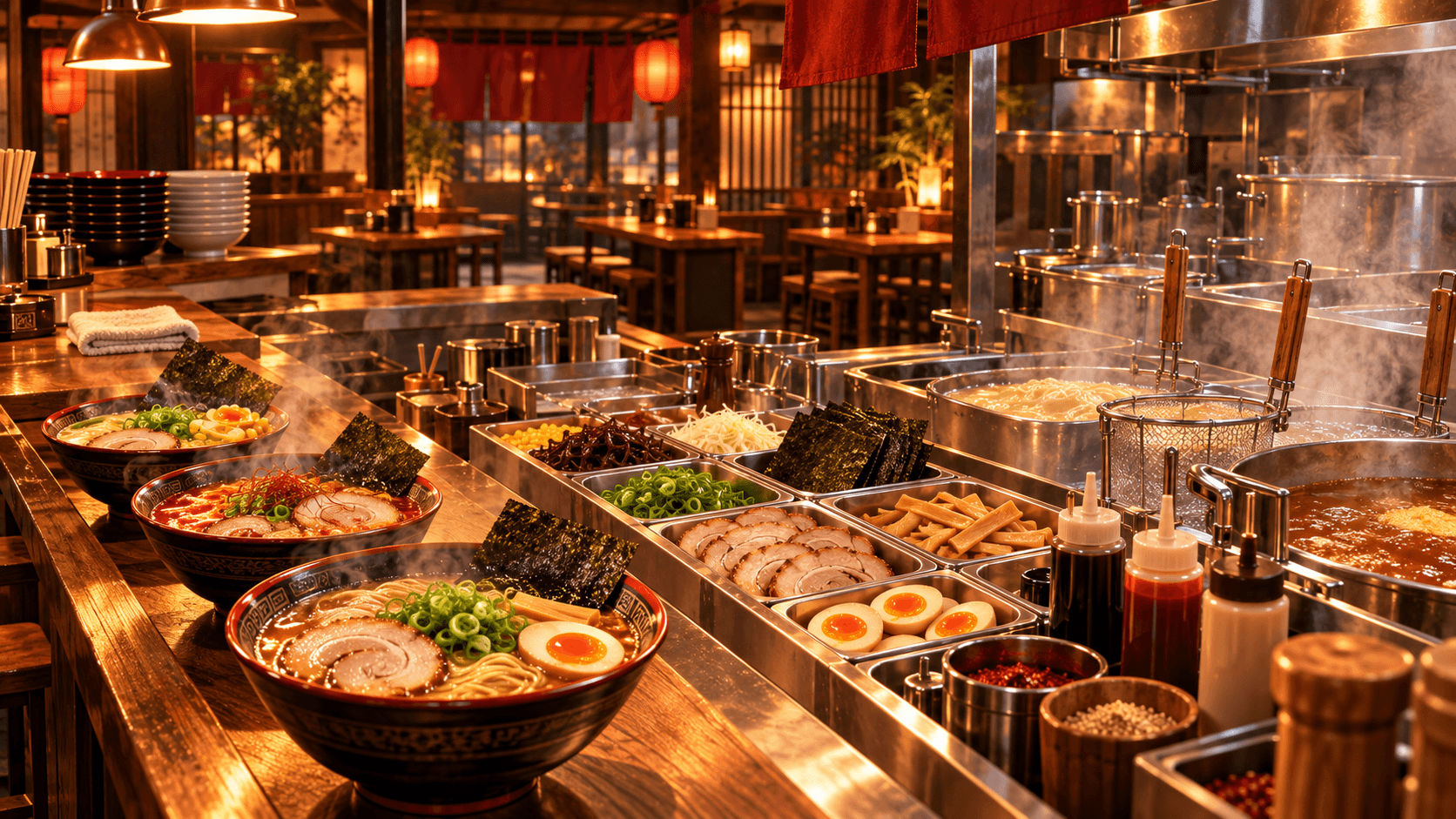
Recipes in Japanese Ramen Simulator are built through physical preparation rather than a single recipe-menu click. Prepare a soup, boil and drain noodles, place them in a bowl, add the appropriate sauce and toppings, then serve the result that matches the customer’s order. Official Steam material confirms that noodle doneness, soup temperature, aroma, umami, presentation, and serving speed contribute to cooking, but it does not publish a universal best temperature, exact timer, or ingredient ratio. Start by matching the requested bowl accurately; experiment with signature ramen only after the service workflow is stable and supplies are organized.
Accuracy note: Third-party temperature, Brix, timing, ratio, and profit estimates are not treated as official recipes here.
How Ramen Preparation Works
The official loop has four connected stations: soup, noodles, toppings, and service. Ingredients chosen for soup affect aroma and umami; noodle handling affects doneness; toppings affect both the requested order and the final presentation. Because objects are handled physically, a clean transfer path between stations matters almost as much as knowing what belongs in the bowl.
Use one consistent order of work:
- Read the customer request completely.
- Confirm the required soup style, sauce, and toppings.
- Start the element that takes longest at your current station.
- Prepare the bowl and toppings while noodles are cooking.
- Drain the noodles and move them into the intended bowl.
- Add soup and sauce without mixing bottles or bowls between orders.
- Add the requested toppings, verify the finished bowl, and serve promptly.
If these steps are still unfamiliar, the beginner guide covers the whole first-shift loop.
Broth and Soup Base
Steam confirms that players prepare soup and choose combinations of ingredients to influence aroma and umami. Collected gameplay footage also shows players adding soup ingredients and water to a pot, waiting for the soup, and then using that prepared soup during assembly. The collected sources do not establish one official formula that is best for every order.
Treat the soup station as a batch-production area. Keep its ingredients and tools together, leave space to handle a pot safely, and tell the rest of the team when a batch is ready or running low. Do not let a nearly empty pot become a surprise during a rush.
Confirmed Soup and Sauce References
Current official material explicitly mentions pork soup, chicken soup, beef soup, soy sauce, miso, and tantan sauce across the store description and Day 1 notes. This is evidence that these bases or sauces exist, not a complete recipe list and not proof that every combination is available at the start.
The Day 1 update confirms tantan sauce is purchasable at Shop Level 26. Orders for chicken- or pork-soup tantan ramen unlock at Shop Level 26, while beef-soup tantan ramen orders unlock at Shop Level 28. These are version-specific facts for v0.1.48.17626 and may change during Early Access.
Noodles
Official Steam copy says noodle doneness matters. The game also includes tutorial tracking for draining noodles, and the Day 1 update fixed an issue where spilled noodles could remain visible after being transferred from a noodle basket.
No verified source in the project gives one exact cook time for every noodle or situation. Watch the game’s own state and prompts, avoid leaving finished noodles idle, and build a repeatable handoff from the cooker to the bowl. In co-op, announce when noodles are started and when they are ready so another player does not prepare a duplicate order.
Toppings and Physical Plating
Toppings are placed physically, and Steam describes the presentation as physics-based. That freedom is useful for creating a signature bowl, but customer service still begins with order accuracy. Add the requested type and amount before optimizing appearance.
Official and collected gameplay sources confirm toppings or topping ingredients including nori, green onion, menma, bean sprouts, cabbage, chives, egg, and pork belly or prepared chashu-related items. Availability depends on progression, and this is not an all-ingredients list. See the ingredients guide for source confidence and storage notes.
Match the Customer Order
An attractive bowl can still be the wrong bowl. Keep the order visible, separate active bowls, and use a fixed verification pass before service.
| Check | Ask before serving |
|---|---|
| Customer | Is this bowl going to the correct seat or order? |
| Base | Does the soup and sauce match the request? |
| Noodles | Were the noodles cooked and transferred for this order? |
| Toppings | Are all requested toppings present without accidental extras? |
| Readiness | Is the bowl complete and being served without avoidable delay? |
The Day 1 notes specifically mention that the tutorial can recognize a prepared ramen with nori and that critic prompts can identify toppings while the player is holding ingredients. Those details reinforce that the game tracks bowl composition rather than treating all ramen as interchangeable.
Temperature and Timing
Temperature and serving time are officially confirmed evaluation factors. However, no official source collected for this project supplies a universal target temperature or a fixed number of seconds for each cooking step. Exact figures published by third-party sites should therefore be treated as unverified unless Wild Dog documents them.
The reliable strategy is operational: finish the bowl close to service, avoid making finished ramen far ahead of demand, keep hot work moving toward the customer, and do not let cooked noodles or poured soup wait while the team searches for toppings.
Efficient Cooking Workflow
Efficiency comes from fewer crossings and clearer ownership, not from guessing hidden values.
- Keep soup ingredients near the soup station and toppings near assembly.
- Use a clear landing area for a bowl waiting on its next step.
- Separate incomplete bowls so they cannot be served by mistake.
- Restock before opening and during calm periods.
- Tell teammates when soup, noodles, or a topping is running low.
- Place equipment around the order of use rather than around decoration alone.
As the shop grows, equipment and layout can reduce repeated movement. The upgrades guide explains how to judge those purchases without inventing upgrade statistics.
Common Cooking Mistakes
- Using an unverified “perfect” number. Follow live game feedback instead of a third-party temperature or timer presented without an official source.
- Starting too many bowls. Multiple half-finished orders are harder to verify than one complete order.
- Mixing active orders. Give each bowl a defined place and owner.
- Adding toppings from memory. Recheck the ticket before service.
- Preparing too far ahead. Temperature, doneness, and service time are confirmed quality factors.
- Letting supplies interrupt cooking. Restock the station before the queue grows.
- Pouring sauce while carrying several bottles. The Day 1 update allows up to five sauce bottles to be carried, but instructs players to hold only one when pouring into ramen.
Beyond Ramen
Official Steam information confirms that the Early Access version also includes gyoza cooking, beer service, and rice bowls such as chashu bowls made with prepared ramen ingredients. Those systems are real, but they are not evidence for invented ramen recipes or exact margins. Master the ramen order loop first, then add side dishes only when the kitchen can prepare, plate, and serve them without losing track of the main queue.
For supply planning, continue to Ingredients. For the complete first-day loop, return to the Beginner Guide.